The Missing Link For Water On Earth Might Have Finally Been Found

Have you ever wondered where the water on Earth comes from? You may well assume that it’s always been here because why wouldn’t it have been? Plus, given that it covers more than 70% of the Earth’s surface, it must surely be a natural part of the planet, right? No, as it turns out, it’s not.
When the Earth was formed, it did so as a solid structure without the oceans and rivers we’re familiar with today. That water reportedly came from comets that hit the Earth many years ago. Before the comets, the liquid had apparently been in gas clouds that later moved to planet-forming disks around young stars. However, for the longest time, scientists hadn’t been able to identify how the water transferred to the comets from the latter. That was before the missing link for water on Earth might have finally been found.
Scientists discovered the “missing link” for Earth’s water through V883 Orionis
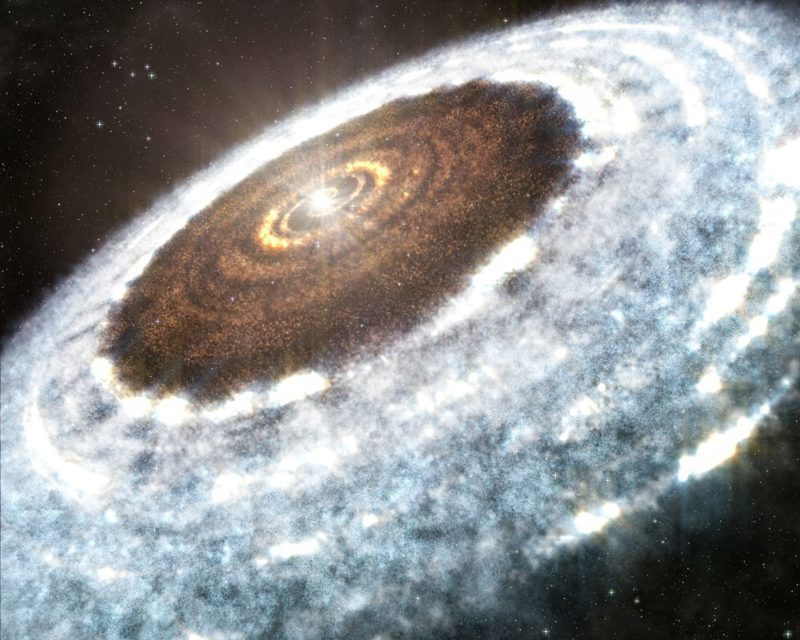
The discovery came courtesy of a radio telescope that was pointed at V883 Orionis. This is a protostar that’s located some 1,300 lightyears away from our planet. Through the telescope, astronomers noted the presence of gaseous water, which apparently shares a similar chemical composition to the water on Earth. The similarity seemingly proves that the water we know today once revolved around an ancient star and made it to this planet relatively unchanged. Astronomers also used the Atacama Large Millimeter/submillimeter Array to identify radiation traces from the water around V883 Orionis. They wanted to prove that the gaseous substance would freeze into comets like the ones that must have hit Earth all that time ago.
V883 Orionis apparently has 1,200 times more water than Earth
Analyzing the water around V883 Orionis effectively involved identifying the ratio of heavy and semi-heavy water. These are variants of water where the hydrogen atoms usually found in its chemistry are reportedly swapped for deuterium. Identifying the ratio of the two variations can apparently indicate how water moves across the solar system. What astronomers found from looking at V883 Orionis is that the planetary disk supposedly has as much as 1,200 times more water than we do in our oceans. Who knows how many planets that could cover if they were ever to be hit by these comets. Of course, a celestial body would still need the right atmosphere for that water to last on the surface.
As with any astronomical discovery, these findings help us to take one step closer to understanding our planet and how it came to be this way. Researchers are reportedly now looking to study the system of water’s journey through space in more detail using the European Space Observatory’s Extremely Large Telescope. Sadly, it will be another five years before it’s set to make its first observations.
You May Also Like
 Education
The Difference Between Correlation and Causation
 Science
Why Some Studies Cannot Be Replicated
 Science
How to Tell a Breakthrough From a Press Release