What Ancient DNA Reveals About Human Migration
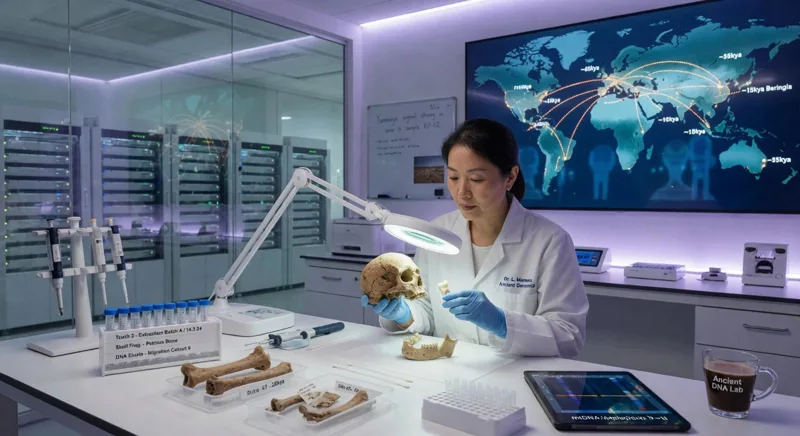
What ancient DNA reveals about human migration is more nuanced—and more surprising—than a simple map of people moving from one place to another. By recovering genetic material from ancient bones, teeth, and sediments, researchers can trace population movements, identify interbreeding, and reconstruct how humans adapted to changing environments.
How Ancient DNA Helps Reconstruct Human History
Archaeology shows where ancient people lived and what they made. Ancient DNA, often called aDNA, adds another layer: it can reveal biological relationships between populations separated by thousands of miles or generations.
Scientists extract DNA from well-preserved remains, especially the dense petrous bone near the inner ear and teeth. They then compare genetic markers from ancient individuals with one another and with modern populations. This can help answer questions such as:
- Where did a population originate?
- Did newcomers replace local communities or mix with them?
- Were similar tools and traditions spread by migration or cultural exchange?
- How did climate, disease, and food production influence human movement?
Ancient DNA does not provide a perfect family tree. Instead, it offers genetic evidence that researchers interpret alongside radiocarbon dating, archaeology, linguistics, and climate records.
The Major Human Migration Story
Genetic research supports the broad conclusion that modern humans originated in Africa before expanding across the world. However, the journey was not one continuous march. Human groups moved in multiple waves, sometimes settling new regions, returning to earlier areas, or mixing with populations already living there.
Evidence also points to interbreeding between Homo sapiens and archaic humans, including Neanderthals and Denisovans. As a result, many people living outside Africa today carry small amounts of Neanderthal ancestry, while populations in parts of Asia and Oceania also preserve Denisovan-related ancestry.
These findings changed the older view that ancient human groups simply disappeared when modern humans arrived. In many cases, migration involved contact, exchange, and genetic admixture.
What Ancient DNA Reveals About European Migration
Europe provides one of the clearest examples of how ancient DNA has reshaped human migration research. Genome studies identify several major population movements:
- Hunter-gatherer expansion: Early modern humans entered Europe tens of thousands of years ago and adapted to Ice Age environments.
- Neolithic farming migration: Beginning around 11,000 years ago, farming communities expanded from the Middle East into Europe. Ancient genomes suggest that these communities were genetically distinct from many local hunter-gatherers.
- Steppe pastoralist expansion: Around 5,000 years ago, populations associated with the Pontic-Caspian Steppe moved into parts of Europe and contributed substantially to later populations.
Importantly, these migrations did not produce one simple replacement pattern. Some regions show strong population turnover, while others reveal generations of coexistence and intermarriage. Europe functioned as a genetic crossroads, with repeated movement across its landscapes.
Migration Was Not Always the Same as Cultural Change
One of the most valuable lessons from ancient DNA is that culture can spread without large-scale population movement. A new technology, farming practice, language, or religious tradition may be adopted by neighboring communities rather than carried by a mass migration.
Research on ancient North Africa, for example, has shown that the spread of pastoral practices in parts of the Sahara may have involved cultural transmission more than major population replacement. This distinction helps researchers avoid assuming that new tools or customs automatically indicate the arrival of a new people.
Tracing Ancient Migration Beyond Europe
Ancient DNA is also illuminating migration routes across Asia, the Pacific, the Americas, and Africa. Genetic evidence has helped connect ancient Arctic populations with later groups in northeastern Siberia and Greenland, revealing long-distance movement across challenging environments.
In the Pacific, ancient genomes have clarified that migration occurred in stages. Early settlers and later voyagers contributed different ancestry components to island populations, demonstrating that ocean travel, regional interaction, and settlement were complex processes.
In Asia, DNA from ancient individuals is especially valuable because the region contains major migration corridors linking Europe, the Middle East, Siberia, and East Asia. New discoveries continue to fill gaps in areas where archaeological evidence is limited or poorly preserved.
What Ancient DNA Cannot Tell Us
Ancient DNA is powerful, but it has limitations. DNA breaks down over time, and warm or humid climates can destroy genetic material quickly. Available samples may also be geographically uneven, meaning some populations are studied far more often than others.
Researchers must also be cautious when interpreting ancestry. Genetic similarity does not always prove a direct migration from one specific location. Populations can share ancestry through older connections, repeated intermarriage, or now-lost intermediary groups.
Ancient DNA can reveal biological relationships, but it cannot independently determine a person’s language, identity, beliefs, or cultural affiliations. Those questions require archaeological and historical context.
The Ethics of Ancient DNA Research
Studying human remains raises important ethical responsibilities. Ancient individuals are not merely sources of genetic data, and many remains are connected to living descendant or Indigenous communities.
Responsible research should minimize damage to remains, explain how genetic data will be stored and shared, and involve relevant communities throughout the project. Indigenous data sovereignty is particularly important when studies concern ancestors connected to present-day peoples.
Ethical ancient DNA research therefore combines scientific rigor with consultation, respect, and long-term accountability.
Why Ancient DNA Matters Today
Ancient DNA reveals that human history is shaped by movement, adaptation, cooperation, and mixing—not by isolated populations living unchanged for millennia. It helps explain the origins of genetic diversity, the spread of agriculture, the impact of climate change, and the deep connections between populations.
Most importantly, it replaces overly simple migration stories with a richer picture. Human movement was rarely a single event. It was a continuing process of journeys, encounters, adaptations, and shared ancestry.
As researchers recover DNA from more regions and improve methods for analyzing damaged genetic material, ancient DNA will continue to refine our understanding of how people populated the world—and how closely connected human communities have always been.
References
You May Also Like
 Education
The Difference Between Correlation and Causation
 Science
Why Some Studies Cannot Be Replicated
 Science
How to Tell a Breakthrough From a Press Release