How Underwater Robots Explore Hidden Ecosystems
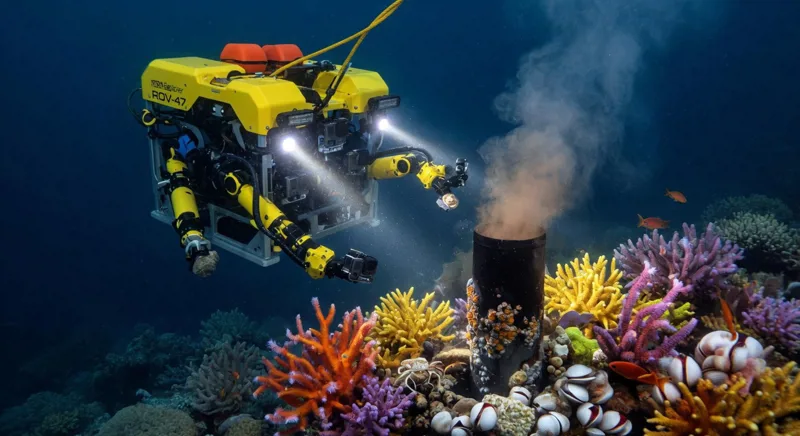
How underwater robots explore hidden ecosystems is a story of smart engineering, advanced sensors, and careful scientific observation. From deep-sea coral gardens to hydrothermal vents, these machines reveal places that are too dark, deep, cold, or dangerous for human divers to visit safely.
Why Underwater Robots Matter
Most of the ocean remains difficult to access. Extreme pressure, low temperatures, poor visibility, and long distances from shore make deep-sea exploration challenging for people. Underwater robots provide a safer and more efficient way to study marine life, ocean habitats, and the seafloor.
Researchers use underwater robots to collect information without disturbing fragile ecosystems. Their missions can support marine biology, ocean mapping, climate research, conservation planning, and environmental monitoring.
What Types of Underwater Robots Explore the Ocean?
Although underwater robots come in many designs, two major categories dominate scientific exploration: remotely operated vehicles and autonomous underwater vehicles.
Remotely Operated Vehicles
A remotely operated vehicle, or ROV, is connected to a research ship by a cable. The cable supplies power and transmits commands, video, and data between the vehicle and operators on the surface.
ROVs are especially useful when scientists need to watch a live video feed or collect specific samples. Pilots can guide the robot toward a coral colony, volcanic vent, wreck, or unusual animal. Robotic arms can then collect rocks, water, sediment, or biological specimens with precision.
Autonomous Underwater Vehicles
An autonomous underwater vehicle, or AUV, operates without a tether. Scientists program its route before deployment, and onboard computers guide it through the mission. Afterward, the vehicle returns to a planned location so researchers can recover it and download the data.
AUVs are ideal for broad surveys, detailed seafloor mapping, and missions where a tether would limit movement. Many carry sonar systems, cameras, chemical sensors, and instruments that measure water conditions.
Hybrid and Specialized Robots
Some modern vehicles combine autonomous navigation with remote control. A hybrid robot may travel independently across a survey area and then allow scientists to take direct control when it finds something important.
Other designs include underwater gliders, small robotic vehicles for coral monitoring, and deep-sea systems built to operate thousands of meters below the surface.
How Underwater Robots Explore Hidden Ecosystems
The exploration process usually follows several carefully planned stages.
- Mission planning: Scientists identify the habitat or research question, select a vehicle, and define the survey route.
- Deployment: The robot is lowered from a ship or released from the surface.
- Navigation: The vehicle uses computers, acoustic signals, inertial sensors, and other systems to maintain its position.
- Data collection: Cameras, sonar, chemical sensors, and sampling tools record information about the environment.
- Recovery and analysis: Researchers retrieve the vehicle, process its data, and compare findings with earlier surveys.
This combination of robotics and marine science allows researchers to study ecosystems in remarkable detail while reducing the need for physical contact.
Which Sensors Help Robots Find Marine Life?
Underwater robots act as mobile laboratories. Their sensor packages vary by mission, but common tools include:
- High-definition cameras: Capture images and video of animals, plants, geological formations, and human-made objects.
- Multibeam sonar: Creates detailed maps of the seafloor, even in darkness or murky water.
- Acoustic sensors: Detect animals, measure distances, and help the robot navigate.
- Water-quality instruments: Measure temperature, salinity, oxygen, acidity, and currents.
- Chemical sensors: Identify substances associated with hydrothermal vents, pollution, or biological activity.
- Laser scanners: Estimate the size and shape of organisms or geological structures.
- Sampling equipment: Collect sediment, seawater, rocks, or carefully selected biological material.
Artificial intelligence can also help identify fish, jellyfish, corals, and other organisms in large collections of underwater images. This saves scientists time and makes long-term ecosystem monitoring more practical.
What Hidden Ecosystems Can Robots Discover?
Underwater robots have helped researchers investigate environments that were previously difficult to observe, including:
- Deep-sea coral gardens
- Hydrothermal vents and cold seeps
- Submerged caves and canyons
- Polar habitats beneath sea ice
- Seagrass meadows and kelp forests
- Shipwrecks and underwater archaeological sites
- Deep ocean trenches and previously unmapped seafloor
These habitats can support unique communities of organisms. At hydrothermal vents, for example, life can depend on chemical energy rather than sunlight. Robots make it possible to observe these communities, measure their conditions, and understand how they change over time.
How Robots Help Protect Ocean Ecosystems
Exploration is not only about discovery. Repeated robotic surveys can show whether coral habitats are growing, damaged, or recovering. Images and sonar maps can reveal the effects of fishing gear, pollution, warming water, coastal construction, and other pressures.
Because robots can return to the same location, they provide valuable baseline data. Conservation teams can use that information to identify vulnerable habitats and make better decisions about protected areas.
The Challenges of Robotic Ocean Exploration
Underwater robots are powerful, but they are not effortless to operate. Saltwater can damage electronics, communication signals travel differently underwater, and GPS does not work normally below the surface. Batteries also limit mission duration.
Researchers must account for strong currents, rough seas, limited visibility, and the risk of losing an expensive vehicle. Data analysis is another challenge: a single mission can produce hours of video, thousands of images, and extensive sonar files.
The Future of Underwater Exploration
Future underwater robots will likely become smaller, more energy-efficient, and better at working together. Groups of autonomous vehicles could survey large areas, while artificial intelligence helps identify species and unusual environmental changes in real time.
As robotic technology improves, scientists will be able to explore more of the ocean with less disturbance. The result will be a clearer picture of how hidden ecosystems function—and how people can protect them.
Conclusion
How underwater robots explore hidden ecosystems comes down to three abilities: reaching difficult places, collecting precise data, and observing marine life with minimal disruption. ROVs provide live control and detailed sampling, while AUVs cover broad areas independently. Together, these machines are transforming ocean exploration and helping researchers understand the unseen habitats that sustain life beneath the waves.
References
You May Also Like
 Education
The Difference Between Correlation and Causation
 Science
Why Some Studies Cannot Be Replicated
 Science
How to Tell a Breakthrough From a Press Release