The Science of Batteries Beyond Lithium-Ion
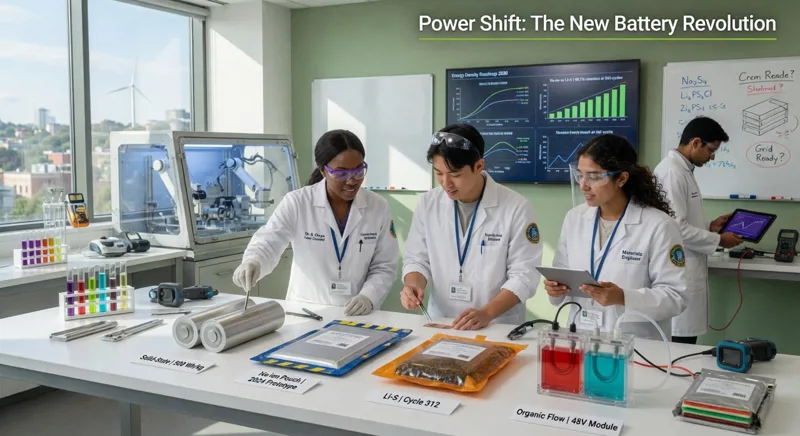
The Science of Batteries Beyond Lithium-Ion is reshaping energy storage for electric vehicles, renewable energy, portable electronics, and the power grid. From sodium-ion and solid-state batteries to lithium-sulfur and flow batteries, each technology tackles a different weakness of conventional lithium-ion cells.
Why Look Beyond Lithium-Ion?
Lithium-ion batteries remain highly capable, but their chemistry has trade-offs. They depend on materials such as lithium, graphite, nickel, cobalt, and copper, whose supply chains can be costly, geographically concentrated, or environmentally demanding.
Battery researchers are therefore pursuing alternatives that may offer:
- Lower battery manufacturing costs
- Improved safety and thermal stability
- Higher energy density and longer driving range
- Reduced dependence on critical minerals
- Better performance for grid-scale and long-duration energy storage
- More sustainable battery recycling and materials recovery
No single chemistry is likely to replace lithium-ion everywhere. Instead, the future battery market will probably include several technologies, each matched to a particular application.
How Battery Chemistry Determines Performance
Every rechargeable battery has three essential components: a cathode, an anode, and an electrolyte. During discharge, ions move through the electrolyte while electrons travel through an external circuit, creating usable electrical power. Charging reverses that process.
The choice of materials controls a battery’s energy density, power output, charging speed, cycle life, operating temperature, safety, and cost. For example, a chemistry designed for electric cars may prioritize lightweight energy storage, while a grid battery may value low cost and thousands of reliable cycles.
Sodium-Ion Batteries: A Practical Lithium Alternative
Sodium-ion batteries operate on a principle similar to lithium-ion batteries, but they move sodium ions instead of lithium ions. Sodium is widely available and can reduce exposure to lithium supply constraints. These batteries can also use materials such as hard carbon and iron- or manganese-based cathodes.
The main advantage is resource availability. Sodium-ion technology may be especially useful for affordable electric vehicles, stationary storage, and applications where maximum range is less important.
Its main limitation is lower energy density compared with many lithium-ion designs. Because sodium ions are larger and heavier than lithium ions, sodium-ion battery cells generally store less energy for the same weight and volume.
Even so, sodium-ion batteries are attractive because they can operate at room temperature and may reduce reliance on expensive or strategically sensitive materials. They are among the leading candidates for commercial batteries beyond lithium-ion.
Solid-State Batteries and Safer Electrolytes
Most conventional lithium-ion batteries use a liquid electrolyte. Solid-state batteries replace that liquid with a solid material, such as a ceramic, sulfide, or polymer electrolyte.
This design could improve safety by reducing the risk of leaks and flammable electrolyte fires. Solid electrolytes may also enable the use of lithium-metal anodes, which could significantly increase energy density and extend electric vehicle range.
Why Solid-State Batteries Are Difficult to Build
Solid-state battery research faces several engineering challenges:
- Maintaining low-resistance contact between solid layers
- Preventing cracks and mechanical damage during cycling
- Controlling dendrites that can grow through the electrolyte
- Manufacturing thin, defect-free layers at high volume
- Balancing fast charging with long battery life
Solid-state batteries are promising, but laboratory performance does not automatically translate into affordable mass production. Manufacturing yield, durability, and battery cost will determine how quickly they reach mainstream vehicles and consumer devices.
Lithium-Sulfur: More Energy With a Different Problem
Lithium-sulfur batteries still use lithium, but they replace conventional cathode materials with sulfur. Sulfur is abundant, inexpensive, and comparatively lightweight. In theory, this chemistry can deliver much higher specific energy than today’s lithium-ion batteries.
The difficulty is cycle life. During operation, sulfur forms soluble intermediate compounds known as polysulfides. These compounds can migrate through the electrolyte, causing capacity loss and chemical degradation. The lithium-metal anode can also develop dendrites and other forms of instability.
Researchers are exploring protective coatings, advanced electrolytes, porous carbon structures, and redesigned separators to control these effects. Lithium-sulfur batteries may eventually serve aviation, drones, and other applications where low weight matters more than long cycle life.
Flow Batteries for Long-Duration Energy Storage
Flow batteries use liquid electrolytes stored in external tanks. Pumps move the liquids through an electrochemical stack, where charging and discharging occur. Unlike a conventional battery cell, a flow battery’s power and energy capacity can be scaled separately.
A larger stack increases power, while larger tanks increase energy storage duration. This makes flow batteries particularly useful for solar farms, wind projects, microgrids, and utility-scale backup power.
Advantages include:
- Long service life
- Excellent suitability for multi-hour storage
- Low fire risk in many designs
- Simple capacity expansion through larger electrolyte tanks
Flow batteries are usually too large and heavy for electric cars. Their value lies in storing renewable electricity for several hours, helping stabilize the grid when sunlight or wind production changes.
Other Battery Technologies to Watch
Researchers are also developing zinc-ion, iron-air, aluminum-ion, magnesium-ion, sodium-sulfur, and metal-air batteries. Each uses different materials and reaction mechanisms.
| Technology | Potential strength | Key challenge |
|---|---|---|
| Zinc-ion | Abundant materials and improved safety | Lower energy density and electrode degradation |
| Iron-air | Very long-duration grid storage | Slow response and low power density |
| Metal-air | Extremely high theoretical energy density | Air-electrode durability and efficiency |
| Magnesium-ion | Potentially safer metal anode | Slow ion movement and electrolyte limitations |
What Will Batteries Beyond Lithium-Ion Cost?
Battery cost depends on raw materials, manufacturing scale, supply chains, performance, safety systems, and recycling requirements. A chemistry with inexpensive materials may still be costly if it requires specialized equipment or operates at high temperatures.
For consumers, the relevant measure is not only battery price per kilowatt-hour. Total ownership also includes charging efficiency, replacement frequency, maintenance, usable capacity, and expected cycle life. For utilities, the cost of storing electricity for each hour of operation can matter more than the battery’s purchase price.
The Future of Energy Storage
The science of batteries beyond lithium-ion is not about finding one perfect replacement. It is about matching chemistry to purpose.
Sodium-ion batteries may support affordable mobility and stationary storage. Solid-state batteries could improve electric vehicle range and safety. Lithium-sulfur may serve weight-sensitive applications, while flow, iron-air, and sodium-based systems could support renewable power over many hours.
The winning technologies will combine reliable performance, scalable manufacturing, responsible sourcing, and practical battery recycling. As energy systems become more electrified, this diverse portfolio of chemistries will help make clean electricity more affordable, resilient, and available when people need it most.
References
You May Also Like
 Education
The Difference Between Correlation and Causation
 Science
Why Some Studies Cannot Be Replicated
 Science
How to Tell a Breakthrough From a Press Release