How to Tell a Breakthrough From a Press Release
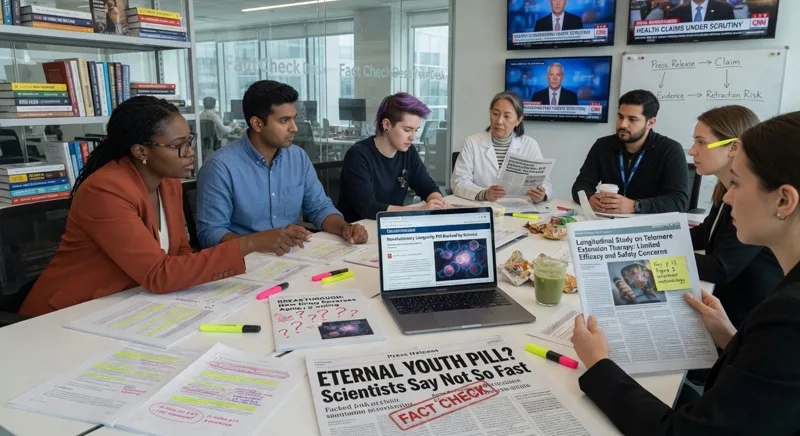
Scientific headlines often promise a “major breakthrough,” but the evidence may be less dramatic than the announcement. Learning how to tell a breakthrough from a press release helps you separate meaningful discovery from clever wording, preliminary research, and science hype.
What Counts as a Real Breakthrough?
A genuine breakthrough is more than an exciting result or a bold claim. It usually changes what researchers can explain, measure, or achieve—and survives careful testing by people who were not involved in the original work.
That does not mean every breakthrough is immediately practical. A discovery in basic science may take years to influence medicine, technology, or everyday life. However, strong breakthroughs typically have several features in common:
- A clearly described research question
- Evidence published in a credible, peer-reviewed journal
- Methods detailed enough for other researchers to assess or repeat
- Results that match the study design and data
- Independent confirmation or replication
- Acknowledged limitations and competing explanations
Peer review is a useful quality signal, but it is not a guarantee that a finding is correct. Reviewers evaluate the evidence presented in a paper; later replication is what helps show whether the result is durable.
What Is a Press Release?
A press release is a communication document designed to attract attention to an announcement. Universities, companies, government agencies, research institutes, and public-relations firms use press releases to summarize new studies, products, funding, patents, or organizational achievements.
Press releases can provide helpful context, but they are not research papers. Their goal is communication—not necessarily a complete presentation of methods, uncertainty, statistical analysis, or alternative interpretations.
A press release may accurately describe a study while still using attention-grabbing language. Words such as “revolutionary,” “game-changing,” “first-ever,” and “miracle” should prompt closer examination rather than instant acceptance.
How to Tell a Breakthrough From a Press Release
1. Find the Original Research
Start by looking for the underlying paper, clinical trial record, technical report, or openly available preprint. A strong announcement should identify what research supports its claims.
Be cautious when an alleged breakthrough exists only in a company statement, media interview, conference presentation, or promotional webpage. A press release without accessible evidence is an announcement—not proof.
2. Check Whether the Study Was Peer-Reviewed
Peer review means independent experts examine a manuscript’s methods, reasoning, analysis, and conclusions before publication. It can identify unsupported claims and important weaknesses, although it cannot detect every error or replace independent replication.
Peer-reviewed publication is therefore one checkpoint, not the finish line. A single published study may be promising, but it should not automatically be treated as settled science.
3. Match the Claim to the Study Design
The type of research matters. Laboratory results, animal studies, computer simulations, observational studies, and randomized clinical trials answer different questions.
- Cell or animal research: May reveal mechanisms, but does not prove the same effect occurs in humans.
- Observational research: Can identify associations, but usually cannot establish cause and effect by itself.
- Randomized trials: Can provide stronger evidence about whether an intervention causes an outcome.
- Engineering demonstrations: May show technical feasibility without proving reliability, affordability, or real-world performance.
If a press release turns an early laboratory result into a claim about human health, consumer savings, or immediate market impact, the language may be outrunning the evidence.
4. Look Beyond the Headline Numbers
Large percentages can sound impressive without showing meaningful real-world benefit. Check the sample size, comparison group, absolute results, and uncertainty around the estimate.
For example, a treatment described as reducing risk by 50% may lower risk from 2% to 1%. Both figures are mathematically correct, but the absolute difference provides more useful context.
Also ask whether the result was statistically significant, clinically meaningful, or merely interesting. These are not interchangeable terms.
5. Read the Limitations
A credible paper usually explains what the researchers could not establish. Limitations may include a small sample, short follow-up, missing data, selection bias, untested populations, or reliance on self-reported outcomes.
Press releases often mention limitations briefly—or leave them out entirely. Compare the announcement with the paper’s discussion section. If the press release sounds certain while the researchers are cautious, trust the fuller scientific account.
6. Investigate Funding and Conflicts of Interest
Funding does not automatically invalidate research, but it can help explain the context and incentives behind a claim. Look for industry sponsorship, patent ownership, consulting relationships, or involvement by organizations that may benefit financially.
The key question is not simply, “Who paid for the study?” Ask whether the methods were transparent, whether the analysis was independent, and whether outside researchers have reached similar conclusions.
7. Search for Independent Replication
Replication is one of the strongest ways to distinguish a durable discovery from a preliminary result. Independent teams should be able to test the same idea and obtain compatible findings.
Repeated results from different laboratories, hospitals, datasets, or research groups strengthen confidence. A striking result that has not been replicated may still be valuable, but it should be described as promising or preliminary—not proven.
Breakthrough or Hype? A Quick Comparison
| Question | Stronger evidence | Warning sign |
|---|---|---|
| Where is the evidence? | Accessible study with detailed methods | Only a press release or interview |
| Who checked it? | Peer reviewers and independent experts | Only the organization making the claim |
| Has it been repeated? | Independent replication | No outside confirmation |
| How precise is the language? | Specific results and limitations | Vague superlatives and absolute promises |
| Does the claim fit the research? | Conclusions match the study design | Animal, laboratory, or observational results generalized broadly |
A Five-Minute Fact-Checking Routine
- Locate the original study or dataset.
- Identify whether it is peer-reviewed, a preprint, or unpublished research.
- Check the sample size, comparison group, and research design.
- Read the limitations and funding disclosures.
- Search for independent expert commentary and replication.
Use precise language while the evidence is developing. “Researchers reported an encouraging early result” is often more accurate than “Scientists achieved a breakthrough.”
The Bottom Line
Knowing how to tell a breakthrough from a press release means looking past confident headlines and examining the evidence beneath them. A real scientific advance is supported by transparent methods, appropriate analysis, peer review, honest limitations, and—ideally—independent replication.
Press releases are useful starting points, but they are not the final verdict. Follow the research, question the wording, and let the strength of the evidence—not the excitement of the announcement—determine how seriously to take the claim.
References
You May Also Like
 Education
The Difference Between Correlation and Causation
 Science
Why Some Studies Cannot Be Replicated
 Science
What Makes a Material Biodegradable?