Ancient Technologies That Still Impress Engineers
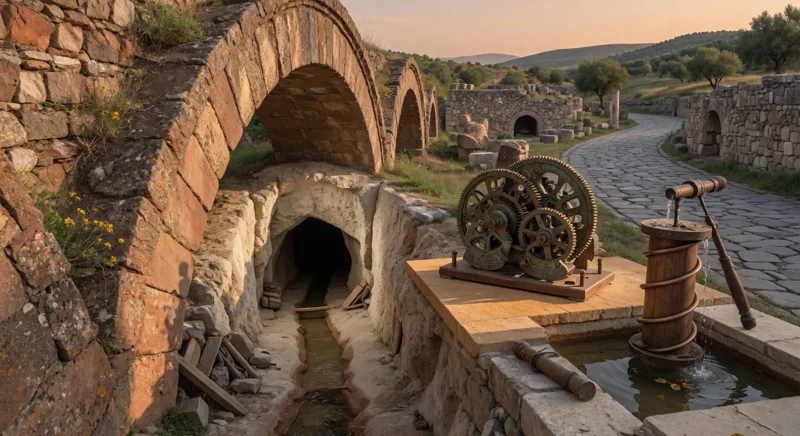
Ancient technologies that still impress engineers reveal a timeless truth: groundbreaking innovation does not always require electricity, advanced software, or modern factories. From earthquake-resistant masonry to precision astronomical calculators, ancient civilizations solved complex problems with observation, mathematics, and remarkable craftsmanship.
Why Ancient Engineering Still Matters
Ancient engineering was often shaped by necessity. Builders had to move water, cross difficult terrain, preserve food, construct durable roads, and understand the movement of the sun and stars. Without modern surveying equipment or computer-aided design, they developed practical systems that could operate for centuries.
These inventions remain relevant because they demonstrate core engineering principles: efficient use of materials, gravity-fed systems, modular construction, mechanical advantage, and careful adaptation to local conditions.
Roman Concrete: A Durable Building Material
Roman concrete, known as opus caementicium, is one of the most famous examples of ancient construction technology. Roman builders combined lime, water, aggregate, and volcanic ash called pozzolana to produce a hydraulic mortar capable of hardening in damp environments.
This material helped construct harbors, bridges, aqueducts, domes, baths, and monumental buildings. Some Roman concrete structures have survived for nearly 2,000 years, particularly those exposed to seawater.[1][2]
Engineers are still interested in Roman concrete because certain mixtures appear to repair small cracks through chemical reactions involving lime particles. Modern researchers study these characteristics while exploring longer-lasting and lower-maintenance concrete.
Qanats and Aqueducts: Water Engineering Without Pumps
Ancient water systems show how effectively engineers used gravity. Persian qanats consisted of gently sloping underground tunnels connected by vertical shafts. These systems collected groundwater and carried it toward settlements and farmland without mechanical pumps.[3][4]
Roman aqueducts applied similar principles on a larger urban scale. Their channels followed the natural contours of the land, maintaining a gradual slope so water could travel from springs to cities. Waterproof coatings, tunnels, bridges, and reservoirs formed part of an integrated water-supply network.
What makes these systems impressive today?
- They used gravity instead of external energy.
- They reduced evaporation by carrying water underground or through covered channels.
- They combined surveying, hydraulics, masonry, and long-term maintenance.
- They supplied growing populations across difficult landscapes.
The Antikythera Mechanism: An Ancient Analog Computer
Recovered from a shipwreck near the Greek island of Antikythera, the Antikythera mechanism dates to around 100 BCE. Its bronze gears modeled astronomical cycles and helped predict events such as eclipses.[6]
The device is extraordinary because it used a compact arrangement of interlocking gears to represent complex relationships in the sky. Its design required knowledge of gear ratios, rotational motion, calendar systems, and astronomy.
Although it was not a computer in the modern electronic sense, the mechanism functioned as a sophisticated analog calculator. It reminds engineers that computation can be mechanical, visual, and physical rather than digital.
Archimedes’ Screw: Simple Mechanics With Lasting Value
The Archimedes’ screw is traditionally associated with the Greek mathematician Archimedes and is generally dated to around the third century BCE. A rotating helical surface enclosed in a cylinder lifts water or other materials from a lower level to a higher one.[5][6]
Its design is remarkably efficient because it transforms rotational motion into steady upward movement. Variations are still used for irrigation, wastewater treatment, grain handling, and industrial material transport.
The technology also demonstrates an important engineering lesson: a simple machine can remain valuable when it is reliable, repairable, and suited to its environment.
Roman Roads and Layered Infrastructure
Roman roads were not merely flat paths. Many were engineered as layered structures, with carefully prepared foundations, stone surfaces, drainage features, and raised edges. Construction methods varied by location, but the basic goal was consistent: create a stable route that could withstand traffic and weather.
This approach resembles modern road engineering, where performance depends heavily on subgrade preparation, drainage, load distribution, and material selection. The Romans understood that a durable surface begins below the visible roadway.
Ancient Earthquake-Resistant Construction
Some ancient builders developed construction methods that reduced damage during earthquakes. Flexible timber frames, smaller masonry units, interlocking stones, and carefully balanced structures could help buildings absorb or redirect movement rather than fail suddenly.
In several historical traditions, builders also separated heavy upper structures from foundations or used layered materials with different levels of flexibility. Modern seismic engineering applies more advanced versions of the same broad idea: control how forces travel through a building.
Damascus Steel and Materials Science
Damascus steel is associated with blades known for distinctive patterns, strength, and sharpness. Historical production methods varied, and the exact meaning of “Damascus steel” can differ between periods and regions.
What continues to interest materials scientists is the relationship between heat treatment, carbon content, forging, impurities, and microscopic structure. Ancient metalworkers achieved useful performance through closely observed processes, even without modern microscopes or laboratory analysis.
What Engineers Can Learn From Ancient Technology
- Use local materials intelligently: Ancient builders often adapted designs to available stone, clay, timber, ash, and water.
- Let physics do the work: Gravity-fed water systems and mechanical screws minimized energy requirements.
- Design for maintenance: Modular roads, tunnels, and channels could be inspected and repaired over time.
- Value durability over novelty: The best technology is not always the newest; it is often the system that performs reliably for generations.
- Combine disciplines: Ancient achievements frequently united mathematics, architecture, metallurgy, astronomy, and practical craft.
Conclusion: Innovation Has Deep Roots
Ancient technologies that still impress engineers are more than historical curiosities. Roman concrete, Persian qanats, Greek gear mechanisms, Archimedes’ screw, and layered roads demonstrate principles that remain central to modern engineering.
Their greatest lesson is not that ancient people possessed mysterious lost technology. It is that careful observation, efficient design, and persistence can produce solutions with extraordinary staying power. In an age focused on smart devices and advanced automation, these enduring systems offer a powerful reminder to design for reliability, efficiency, and the real needs of people.
References
You May Also Like
 Education
The Difference Between Correlation and Causation
 Science
Why Some Studies Cannot Be Replicated
 Science
How to Tell a Breakthrough From a Press Release