The Strangest Creatures To Come From The Mariana Trench

Far longer than the Grand Canyon and far taller than Mount Everest, the Mariana Trench is one of the most imposing natural landmarks in the world. Of course, given it's hidden underwater in the middle of the ocean, we tend to overlook it sometimes. It's always there, though, and some of the stuff it contains is definitely worth mentioning.
There are some incredibly unusual creatures that have made the Mariana Trench their home. With it being so dark and pressurized deep inside, these animals can only survive down there because they've evolved to cope with these conditions. What has that turned them into, though?
Goblin sharks are potentially more terrifying than the rest of their species
We know that sharks are generally quite terrifying animals because of the threat to life they pose. However, perhaps the most horrifying shark of all is the goblin shark, which is one of the strangest creatures to come from the Mariana Trench. There's a lot that someone may find unsettling about this animal, from it's pinkish skin color to its pointed snout to its protruding jaws. The fact that they can be as big as 18 feet as well is certainly not too reassuring. Luckily, as they tend to spend their time thousands of feet below sea level, they're not something we're ever going to accidentally encounter. Still, it's unsettling just knowing that they're out there somewhere.
Deep-sea hatchetfish can camouflage themselves, despite being bioluminescent
With the Mariana Trench being so dark, the creatures down there have had to evolve to cope with the lack of light. In the case of hatchetfish, that has meant developing bioluminescent bodies which brighten the space around them. While this could make them susceptible to predators, the creatures are actually able to alter their brightness to help them camouflage themselves. Although hatchetfish might look quite imposing, the biggest reportedly only grow to be six inches, so they're not something we would ever need to be afraid of. In fact, with these fish supposedly living as far down as almost 5,000 feet, there are definitely other things we'd need to worry about more.
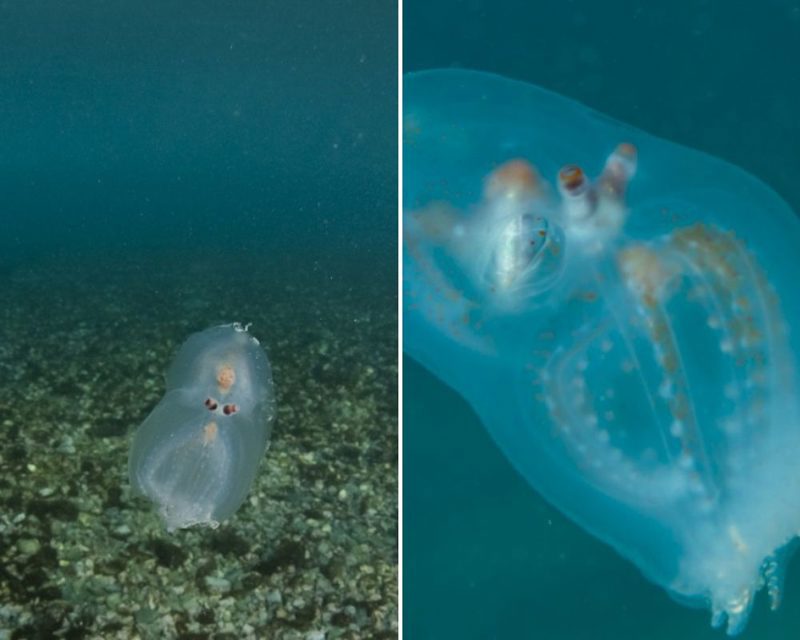
The telescope octopus differs from other octopi in many ways
The telescope octopus isn't like other octopi, which makes sense, given where it lives. While most of these creatures will swim along the floor of the ocean, this octopus actually drifts through the water. What's more, it does so vertically, a move that probably helps it to avoid detection from predators. Of course, given that this animal is virtually transparent, we're amazed that any predator can spot them in the water. To encounter one is like seeing a ghost, especially with the shape that the webbing between its tentacles creates. Fortunately for the telescope octopus, while others may not be able to see it, it can definitely see them. Its protruding eyeballs offer great peripheral vision and can rotate to really see what's going on.
The benthocodon is distinct from other jellyfish in several ways
We reportedly know about more than 2,000 jellyfish species in the world so far, with the possibility that there could be thousands more out there. With there being so many, it's only natural that there are going to be differences between them all, especially those that live in the Mariana Trench. The benthocodon is one such creature, and it's definitely not like you're average jellyfish, with this animal avoiding the transparent design that many other species have. The rounded top - or bell - of this jellyfish is opaque with a reddish coloring, presumably to help avoid detection. Other notable features of the benthocodon include its size - its bell can grow to roughly 1.2 inches in diameter - and the 1500 tentacles it uses to swim around.
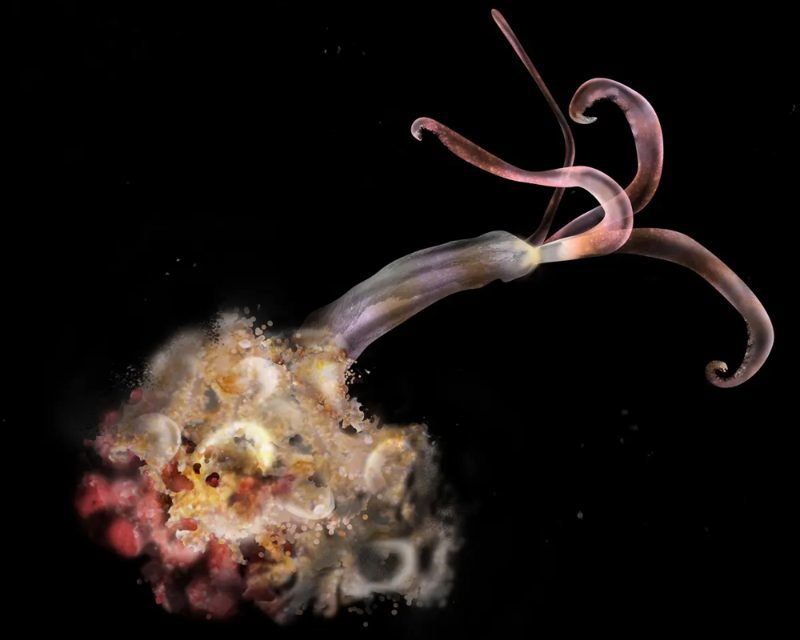
Osedax have concerning nicknames like "bone worm," thanks to their eating habits
With nicknames like "zombie worm" and "bone worm," the osedax doesn't exactly sound like the friendliest of creatures. The tendrils of the osedax are reportedly quite hairy, and it's through the movement of these that the worm apparently gains the oxygen to survive. What's more, it allegedly feasts on bones as big as those produced by whales, using acids and symbiotic bacteria to gain nourishment from the meal. That's pretty impressive, given that the female species don't grow bigger than two inches, while the males are even smaller. As fascinating as these creatures sound, we're kind of glad that they live far away in the Mariana Trench.
The chances are that we're never going to encounter any of the strangest creatures to come from the Mariana Trench. After all, they've evolved to survive at such extreme depths that we can't handle. Of course, who knows what could happen as technology continues to develop. Maybe one day we'll be able to go down there and see these weird and wonderful animals for ourselves.
You May Also Like
 Education
The Difference Between Correlation and Causation
 Science
Why Some Studies Cannot Be Replicated
 Science
How to Tell a Breakthrough From a Press Release