It Turns Out Jumping Spiders Can Go Blind From Hunger

Despite having so many eyes, not a lot of spiders actually have great vision. Many of them rely more on senses like touch and taste to get around and catch their prey rather than sight. However, one species that does reportedly see well is the jumping spider, whose vision is apparently comparable to animals like cats or elephants.
Unfortunately, while they might have great eyesight for a spider, this can apparently change quite quickly. All it takes is for the arachnid to begin starving, and suddenly they can no longer see things like they used to. It turns out jumping spiders can go blind from hunger, which isn't good when these creatures rely on this sense a lot.
A lack of food can apparently cause dark spots in their eyes
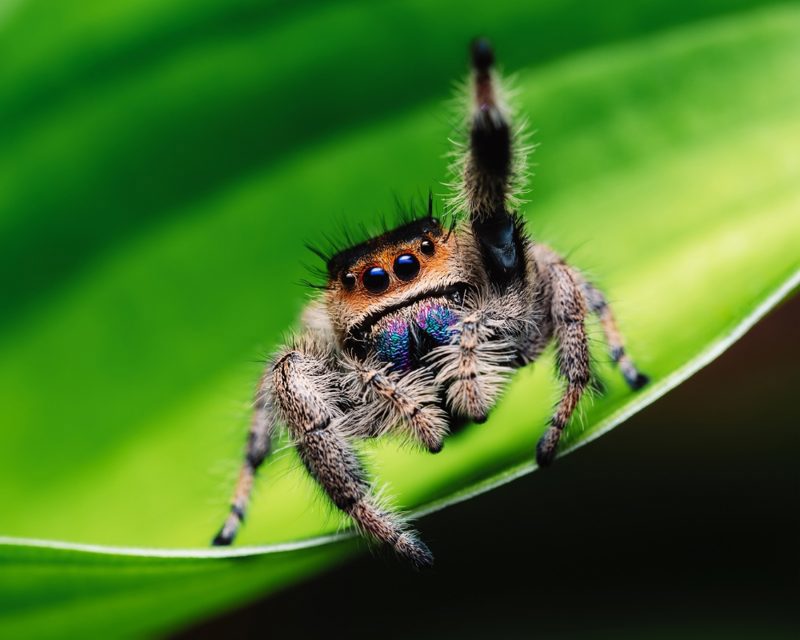
Jumping spiders have more eyes than humans, and it seems they use these for different things. Those that are forward-facing apparently allow the creatures to see with high-resolution color vision, while those on the side show things in black and white. Unfortunately, it seems that all of these eyes are affected when a jumping spider is unable to source food. According to a study in Vision Research, when they don't eat as much food as their bodies need, their eyesight weakens, and it's likely an irreversible change. Elke Buschbeck, who helped to author the study, says that they develop dark spots on their eyes, which would seem to be a sign of degeneration.
Scientists used their technology to examine the eyes of jumping spiders
Scientists were able to first tell that jumping spiders appeared to show deterioration in their vision by using an ophthalmoscope on their eyes. This device can take fluorescent images of the retinas of creatures that are on the smaller side, such as these spiders. Through the ophthalmoscope, they found that there appeared to be spots developing on the arachnids' photoreceptors, suggesting eyesight degeneration. These photoreceptors are what the spiders use to convert light into signals that are then sent to the brain. With an electron microscopy, the scientists were later able to confirm that the cells were indeed deteriorating, indicating that a lack of food seemed to be affecting their vision.
An experiment proved that a lack of food can cause vision degeneration
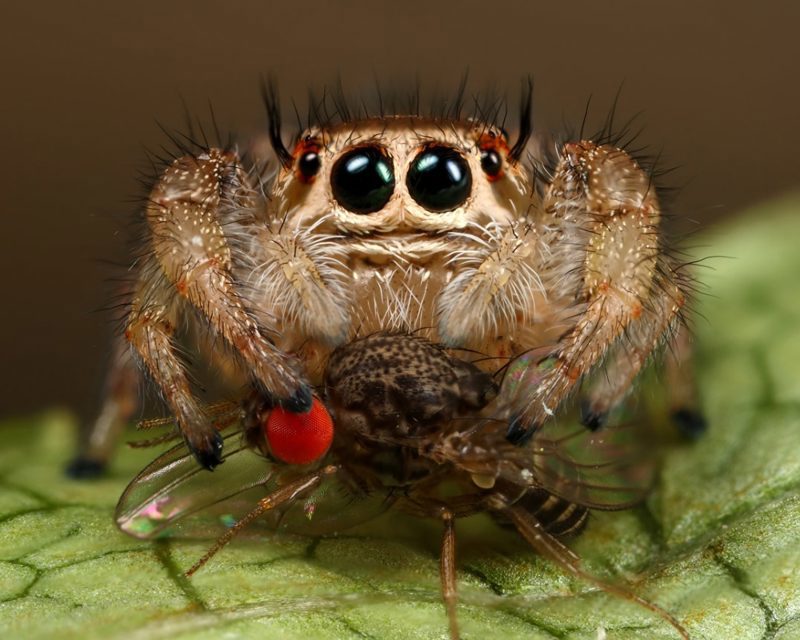
Of course, while there seemed to be a connection between a lack of food and deteriorating vision, the scientists couldn't be sure of the correlation. So, they conducted an experiment where some jumping spiders were fed their normal diet while others only received half of what they'd normally eat. As expected, those that ate less experienced trouble with their vision, with an ophthalmoscope confirming that there was cell degeneration. According to the researchers, this is potentially because the photoreceptors in their eyes require a consistent supply of energy. So, when food intake decreases, there are fewer nutrients available to keep them working at an optimal level. It's possible that a similar thing could happen with humans who develop macular degeneration, although more research is required with this hypothesis.
Being hungry is already bad enough, but losing your vision because of it is a real kick in the teeth. Whether you're a fan of spiders or not, it's hard not to feel sympathy for these little guys.
You May Also Like
 Education
The Difference Between Correlation and Causation
 Science
Why Some Studies Cannot Be Replicated
 Science
How to Tell a Breakthrough From a Press Release