The Sun Is Set To Become A Ring Of Fire Once Again This October

The stars in the sky can offer us the most incredible spectacles when everything aligns just perfectly. From the moon changing color to the sun being blocked out entirely, these astronomical events are always worth looking out for. Luckily, it seems we don't have to wait long for the next one, as October 14 is set to give us another solar eclipse.
Apparently, eclipses happen more often than we thought, with the Natural History Museum saying they occur two to five times a year. However, these aren't total eclipses, with those usually occurring every 18 months or so. Plus, whether or not you actually get to see them depends on where you are in the world when they happen. The good news for Americans is that eight states will be able to enjoy the "Ring of Fire" eclipse happening this October.
The "Ring of Fire" will be visible for those in the path of annularity
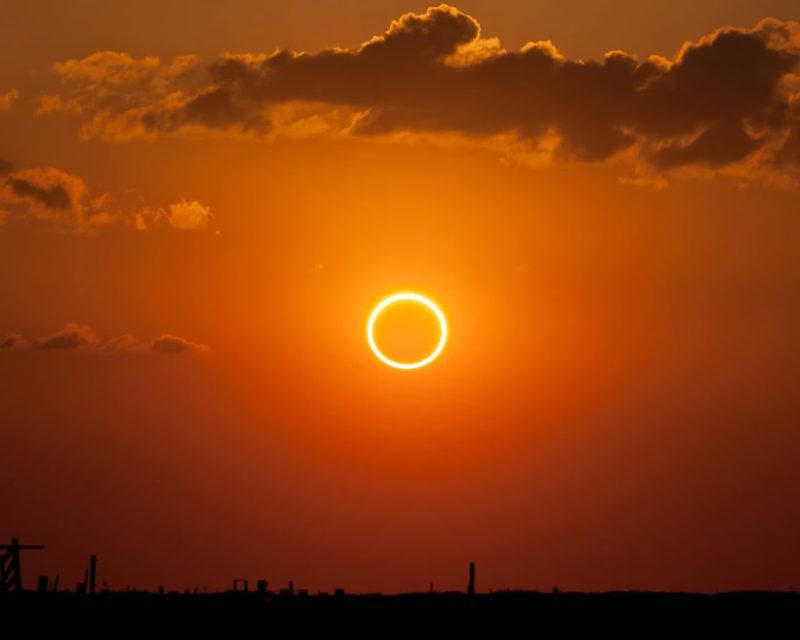
In April 2023, there's set to be a total solar eclipse that will leave parts of the Earth momentarily in darkness. Before that event comes, though, we have this annular solar eclipse that will reportedly block out 90% of the sun. Those in the path of annularity, which stretches down diagonally from southwest Oregon to southeast Texas, will be able to see the event in all its splendor. Anyone in this area who looks up at the sun with eclipse glasses will notice the "Ring of Fire" effect. This is the light of the sun escaping around the moon because the latter isn't close enough to the Earth to completely blot it out. Those who aren't within the path of annularity will see something more akin to the moon taking a "bite" out of the sun.
Some places won't be open due to the Navajo tribe's cultural beliefs

The problem with events like solar eclipses is that there's no guarantee the sky will actually be clear enough for you to witness them on the day. There's no way to completely get around this. However, going somewhere that tends to have a better climate and clearer skies certainly helps. Cartographer Michael Zeiler recommends that people go to the 'Four Corners' that mark the meeting point of Arizona, Colorado, New Mexico, and Utah. Some places you shouldn't go include Monument Valley and Navajo Tribal Park, though that's not because of the weather. Instead, it's because these places will be temporarily closed due to the cultural beliefs of the Navajo tribe. People in the tribe typically stay inside, fasting and praying during a solar eclipse because they believe it marks a new beginning.
The solar eclipse will happen at different times and for various lengths
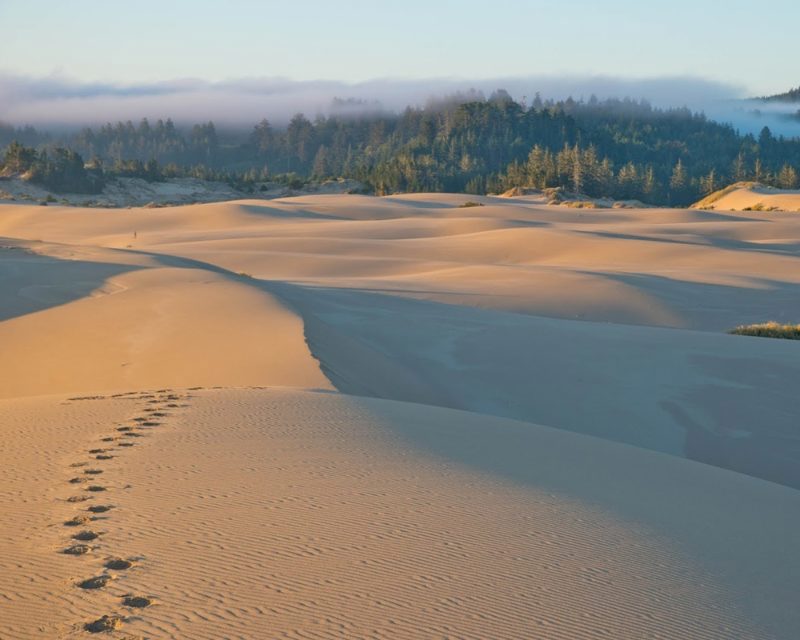
As the eclipse only lasts for a short while, it's not enough to just know what day it's going to happen. You also need to know what time you'll be able to see it. This will vary across the US, as will the duration. For instance, if you're in the Oregon Dunes, you'll be able to catch the eclipse at 9:15 am PDT for approximately four-and-a-half minutes. Someone at Natural Bridges National Monument in Utah would get to see the eclipse for the same amount of time. However, this would be at 10:29 am MDT. Meanwhile, someone in Utah's Bryce Canyon National Park would only get to watch it for two minutes, 31 seconds a few minutes earlier. To see the eclipse for the longest possible time, you'd apparently need to be off the coast of Costa Rica and Nicaragua, where it'll last for roughly five minutes and 17 seconds.
Given that solar eclipses don't happen too often, this is definitely not something to be missed. Unfortunately, if you live in one of the northeastern states like New Hampshire or Maine, you'll only get to see it at about 10-20%. Still, that's better than nothing, right? Plus, if you really wanted to, you could make a spur-of-the-moment trip to somewhere like Nevada, Utah, or New Mexico to see it at its best.
You May Also Like
 Education
The Difference Between Correlation and Causation
 Science
Why Some Studies Cannot Be Replicated
 Science
How to Tell a Breakthrough From a Press Release