What's The Difference Between Caribou And Reindeer?

If you’ve ever watched a nature documentary around the winter time, there’s a good chance you might have seen some of the same animals. However, have you ever found yourself wondering how you can tell the difference between some of them? While that might sound simple when it comes to some of Mother Nature’s creations, there are times when it might get a little confusing.
What’s the difference between caribou and reindeer? In short, it’s all down to part scientific and part cultural. In fact, taxonomists have recently been reevaluating their relationship to see if we’ve been missing something more this entire time.
Caribou and reindeer are both from the Cervidae family
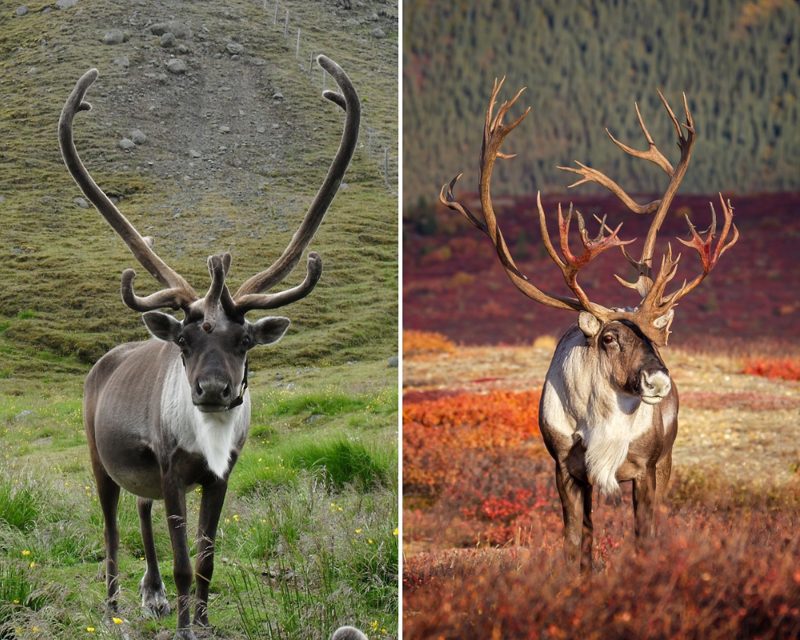
Let’s start at the beginning; it turns out there could be a good reason that so many people get reindeer and caribou confused, as they are both from the family Cervidae. This is also the family where the likes of elk, moose, and white-tailed deer belong. They have plenty in common, too. Like pigs and cows, Cervidaes have hooves and an even number of toes on each foot, but did you know they are spread more across the world than you might think? Yes, Antarctica and Australia are the only places you won’t find Cervidaes. They are also mostly herbivores, relying primarily on shrubs and grass for nutrition. However, it’s their antlers that make them stand out so much. In most species, only males grow antlers, but female and male reindeer and caribou will both grow them throughout the year. They’re made of bone and come with blood vessels and tissue, sometimes measuring as much as 51 inches long, although females tend to have smaller antlers. Males will grow their antlers in February before discarding them in November, while females won’t get new antlers until May or June time.
What’s the difference between caribou and reindeer?
Things get even more confusing when you look at the genus reindeer and caribou belong to, as they both belong to Rangifer. These are found across the world, and for years, taxonomists believed there was only one living species in the genus: Rangifer tarandus. So why are reindeer and caribou called different things? That is all down to where you live. North America refers to caribou if they are in the wild, while they are called reindeer if they’re captive. Then, in Europe, they are just called reindeer. However, as genomic technology has advanced, we learn that the Rangifer tarandus across Europe and Canada might actually be split into several distinct subspecies of their own. Then, in 2022, Dr. Lee Harding argued that there are so many differences between them that they deserve their own species designation altogether.
Splitting up reindeer and caribou could aid their conservation
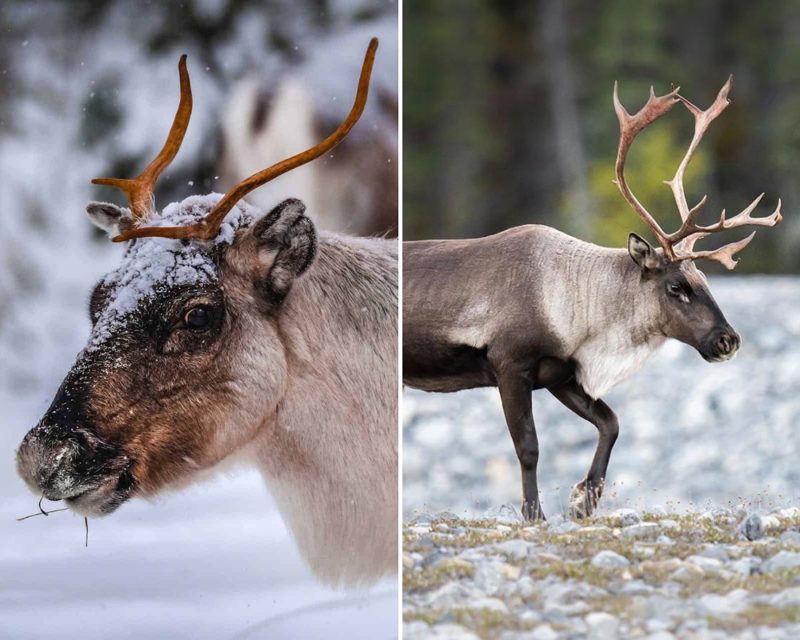
Of course, it might seem trivial to try to split up caribou and reindeer when the names have been interchangeable for so long, but there could be more to it than meets the eye. Dr. Lee Harding argues that in the wild, the “Arctic caribou” and “woodland caribou” have different behaviors, anatomy, and genetics, and they won’t breed with each other in the world. Now, he thinks they need to be split into at least five species: Eurasian tundra reindeer, Svalbard reindeer, Greenland caribou, woodland caribou, and Arctic caribou - but why? That could all be down to their conservation. Between 1990 and 2015, the reindeer population in reindeer fell by 21%, and the last wild caribou population across the US went functionally extinct at some point in the late 2010s. Splitting these into different species could mean more laws can be put in place to protect the animals and give them the conservation status some so desperately need.
What’s the difference between caribou and reindeer? For years, it seemed nothing more than where you lived in the world. However, now that science has come along, it seems there could be more differences between the two winter animals than just where you spot them.
You May Also Like
 Education
The Difference Between Correlation and Causation
 Science
Why Some Studies Cannot Be Replicated
 Science
How to Tell a Breakthrough From a Press Release