How Octopuses Solve Problems Without a Backbone
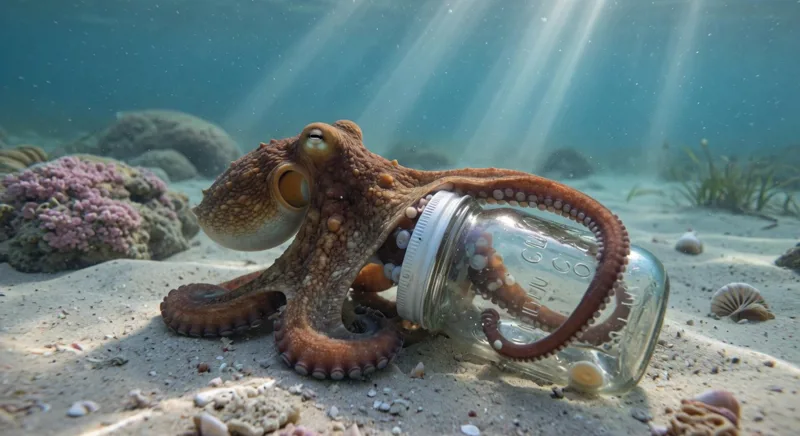
How octopuses solve problems without a backbone is one of nature’s most fascinating stories. These intelligent marine animals use a distributed nervous system, flexible arms, sensitive suckers, and remarkable learning abilities to explore, remember, and respond to challenges without the centralized body plan familiar from vertebrates.
An Octopus Does Not Need a Spine to Think
Humans rely on a backbone and spinal cord to connect the brain with the rest of the body. An octopus has neither. Instead, its nervous system is spread throughout the body, especially across its eight arms.
A common octopus has roughly 500 million neurons. About two-thirds of them are located outside the central brain, with approximately 350 million distributed through the arms. This arrangement gives the animal a form of distributed intelligence, in which local parts of the body can sense and respond to information on their own.[1][3]
That does not mean an octopus has eight completely independent brains. The central brain still helps organize goals, learning, memory, and major movements. However, much of the detailed work is handled locally by the arms and their nerve networks.
How Octopus Arms Help Solve Problems
An octopus arm is more than a flexible limb. It is a sensory and motor system capable of exploring the environment while moving through it.
Each arm contains an axial nerve cord, local nerve centers, muscles, and thousands of sensory suckers. These suckers can detect touch and chemical information, allowing an octopus to “taste” and feel objects as it investigates them.[4][5]
This creates an efficient problem-solving system:
- The eyes identify a possible target or obstacle.
- The brain sets a broad goal, such as reaching food or opening a container.
- An arm explores the immediate surroundings through touch and chemical sensing.
- Local nerve circuits adjust the arm’s movements in real time.
- The brain receives information and updates the animal’s next action.
Instead of sending instructions for every tiny muscle movement, the central brain can provide an overall direction. The arm then handles many details independently. This is especially useful for an animal with no rigid skeleton and eight highly flexible limbs.
Flexible Bodies Create Flexible Thinking
Octopus movement is difficult to control because the animal has no bones or joints. Its arms can bend, twist, shorten, lengthen, and move in several directions at once. Scientists often describe them as muscular hydrostats: structures that maintain volume while changing shape.
A rigid limb may require carefully planned movements around fixed joints. An octopus arm can simply flow around an object, squeeze through a narrow opening, or reach into a crevice. Local nerve circuits help coordinate these complex movements without requiring the brain to calculate every position.
This body design also supports embodied cognition. In simple terms, the octopus does not solve problems with its brain alone. Its body, arms, suckers, eyes, and nervous system work together as one problem-solving network.
Learning Through Touch, Taste, and Exploration
Octopuses are well known for learning from experience. They can associate actions with rewards, remember successful strategies, and adjust their behavior when a familiar approach stops working.
In laboratory maze experiments, octopuses have learned to associate inserting an arm into a particular side of a two-choice maze with receiving food. In some tests, the arm inside the maze detected the relevant information even when the reward and the arm were not visible to the rest of the animal.[2]
This finding reveals an important feature of octopus cognition: sensory information can begin in the arm, while learning and decision-making involve communication with the central brain. The process is neither entirely brain-controlled nor entirely independent. It is a partnership between central planning and local exploration.
Examples of Octopus Problem-Solving
Opening Containers
Some octopuses can manipulate jars, lids, and other objects to reach food. They use vision to understand the object’s structure, then coordinate several arms and suckers to grip, pull, twist, or stabilize it.
Escaping Enclosures
An octopus can investigate weak points in an enclosure, follow openings, and reshape its body to pass through surprisingly small gaps. Because it has no internal skeleton, its soft body can conform to the available space.
Using Objects as Shelter
Some octopuses have been observed carrying shells, coconut shells, and other objects for protection. This behavior requires more than movement. The animal must recognize an object’s usefulness, transport it, and deploy it when needed.
Camouflage and Deception
Octopuses can rapidly alter skin color, patterns, and texture. These changes help them hide, imitate surroundings, communicate, or confuse predators. Camouflage is not just a visual trick; it is a fast decision requiring sensory information, neural control, and precise skin-muscle coordination.
Central Brain and Local Intelligence Work Together
The most accurate way to understand octopus intelligence is not to ask whether the brain or arms are in charge. Both systems contribute different abilities.
| System | Main contribution |
|---|---|
| Central brain | Learning, memory, visual processing, goals, and overall decisions |
| Optic lobes | Major visual processing and interpretation |
| Arm nerve cords | Local movement control and sensory processing |
| Suckers | Touch and chemical sensing |
This division of labor allows an octopus to react quickly without overloading its central brain. The brain can focus on the larger challenge while each arm manages nearby details.
Why This Intelligence Is So Unusual
Octopus intelligence evolved along a very different path from human intelligence. Humans have a centralized brain, a skeleton, and limbs with predictable joints. Octopuses have a soft body, a distributed nervous system, and arms that can sense and act at the same time.
The result is a form of cognition that is highly flexible, sensory, and body-centered. An octopus does not need a backbone to solve problems because its nervous system is not built around a single command pathway. Instead, control is shared across the brain, arms, nerve cords, and sensory suckers.
Conclusion: Intelligence Beyond the Brain
How octopuses solve problems without a backbone teaches a powerful lesson about intelligence: there is more than one way to think. Their brains make plans, but their arms explore. Their eyes identify possibilities, but their suckers investigate details. Together, these systems create an adaptable animal capable of learning, manipulating objects, escaping danger, and responding creatively to its environment.
The octopus is not intelligent despite having a distributed nervous system. It is intelligent partly because of it.
References
You May Also Like
 Education
The Difference Between Correlation and Causation
 Science
Why Some Studies Cannot Be Replicated
 Science
How to Tell a Breakthrough From a Press Release