What Crows Can Teach Us About Intelligence
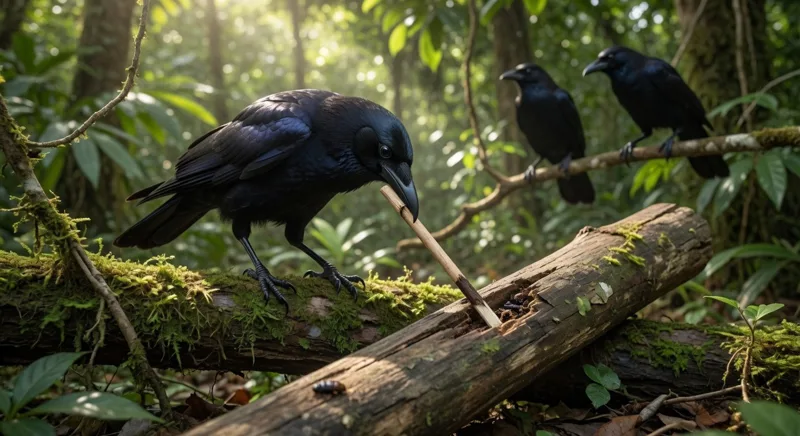
What crows can teach us about intelligence may surprise you: sophisticated thinking is not limited to humans or primates. From making tools to solving unfamiliar puzzles, crows reveal that intelligence can evolve in many forms—and that cleverness is often shaped by the challenges an animal faces every day.
Why Are Crows So Intelligent?
Crows belong to the corvid family, which also includes ravens, rooks, jays, and magpies. Their large brains, flexible behavior, excellent memory, and complex social lives make them some of the most capable problem-solvers in the animal kingdom.
Rather than measuring intelligence by human standards alone, scientists study how animals adapt to new situations. Can they remember important information? Use objects as tools? Learn from experience? Understand cause and effect? Crows perform remarkably well across many of these areas.
Their intelligence is not identical to human intelligence. A crow does not read, build computers, or use language as people do. However, it can solve practical problems with speed and flexibility—skills that are highly valuable in the wild.
1. Crows Show That Tool Use Requires More Than Instinct
One of the best-known examples comes from New Caledonian crows. These birds use sticks, leaves, and other materials to extract insects and food from difficult-to-reach places. They can also modify tools, selecting shapes and materials that work better for a particular task.
In controlled experiments, New Caledonian crows have learned to use unfamiliar objects, including stones, according to their functional properties. This suggests that they are not simply repeating one inherited behavior. Instead, they can recognize what an object does and apply that knowledge in a new situation.
Some crows have even combined several learned actions into a new sequence. For example, a bird may obtain one tool, use it to retrieve a longer tool, and then use the longer tool to reach food. This kind of “tool use within tool use” demonstrates planning and behavioral flexibility.
The broader lesson
Human intelligence also depends on using existing knowledge in new combinations. Whether solving a workplace challenge or fixing something at home, people often succeed by connecting familiar skills in an unfamiliar way.
2. Crows Can Reason About Cause and Effect
Problem-solving becomes especially impressive when an animal understands why something happens—not merely what usually happens next.
In trap-tube experiments, crows learned to move food away from a barrier rather than toward it. When researchers changed the appearance of the equipment, some birds continued to avoid the trap. This indicates that they were responding to the underlying physical relationship, not simply memorizing the color or shape of the apparatus.
Other studies suggest that New Caledonian crows can react differently when an object moves because of a visible event versus an unexplained hidden cause. The birds investigated the situation more cautiously when the movement could not be easily explained.
Researchers describe this ability as evidence of causal reasoning. It does not mean crows think exactly as humans do, but it does show that their decisions can reflect an understanding of physical mechanisms.
3. Crow Memory Is Practical, Detailed, and Social
Crows rely heavily on memory because their survival often depends on remembering locations, individuals, and past experiences.
- They can remember where food has been hidden.
- They recognize familiar people and potential threats.
- They learn from previous mistakes.
- They adjust their behavior after watching other animals.
Food-caching birds face a particularly demanding challenge: they must store food and later recover it, sometimes while other birds are watching. Their behavior suggests that memory is closely linked to social intelligence. A crow may consider not only where food is hidden, but also who observed the hiding process.
This offers an important insight into intelligence: memory is not just the ability to retain facts. It is the ability to store useful information and apply it at the right time.
4. Social Intelligence Can Be Just as Important as Individual Problem-Solving
Crows live in social environments where cooperation, competition, and communication all matter. They observe other birds, respond to warning calls, and learn which people or places are dangerous.
Learning from others can save time and reduce risk. A young crow does not need to personally experience every threat if it can watch an older bird respond. This form of social learning allows useful information to spread through a group.
Human intelligence works in a similar way. Much of what people know comes from observing, teaching, imitation, and shared culture. Crows remind us that intelligence is not only an individual trait—it can also emerge through relationships.
5. Crows Challenge the Idea That Bigger Brains Always Mean Greater Intelligence
Comparisons between crow intelligence and primate intelligence often attract attention because crows have much smaller brains than humans and apes. Yet brain size alone does not determine cognitive ability.
What matters is how the brain is organized, how neurons are distributed, and which abilities an animal’s environment rewards. A crow that must navigate changing landscapes, find hidden food, manipulate objects, and monitor social rivals may develop impressive mental skills without having a primate-sized brain.
This is an example of convergent evolution: different animals independently develop similar abilities because they face similar challenges. Tool use, planning, memory, and flexible problem-solving have appeared in more than one evolutionary lineage.
What Crows Can Teach Us About Human Intelligence
The intelligence of crows offers several practical lessons:
- Intelligence is flexible. The ability to adapt to new problems may matter more than memorizing familiar answers.
- Experience builds better decisions. Crows use past outcomes to change future behavior.
- Creativity often means recombination. New solutions can emerge by combining old skills in new ways.
- Social learning accelerates progress. Watching and learning from others can be more efficient than discovering everything alone.
- Different minds solve different problems. Intelligence should be evaluated in the context of an animal’s natural environment.
Are Crows as Intelligent as Humans?
No direct ranking can capture the full difference between human and crow intelligence. Humans possess unmatched abilities in symbolic language, cumulative culture, abstract mathematics, and large-scale cooperation. Crows excel in other areas, including rapid physical problem-solving, object manipulation, memory for important events, and adapting to everyday challenges.
The more useful question is not whether crows are “as smart as people.” It is how their minds work, which problems they can solve, and what their abilities reveal about the evolution of intelligence.
Conclusion: Intelligence Has More Than One Shape
What crows can teach us about intelligence is simple but profound: clever thinking does not have one universal design. Crows use memory, tools, social knowledge, and causal reasoning to survive in a complicated world.
Studying them expands the definition of intelligence beyond human language and academic achievement. It shows that a capable mind is one that can learn, adapt, remember, and make effective choices when circumstances change. In that sense, crows are not just clever birds—they are a powerful reminder that intelligence comes in many forms.
References
You May Also Like
 Education
The Difference Between Correlation and Causation
 Science
Why Some Studies Cannot Be Replicated
 Science
How to Tell a Breakthrough From a Press Release