Quantum Computing Without the Sci-Fi Hype
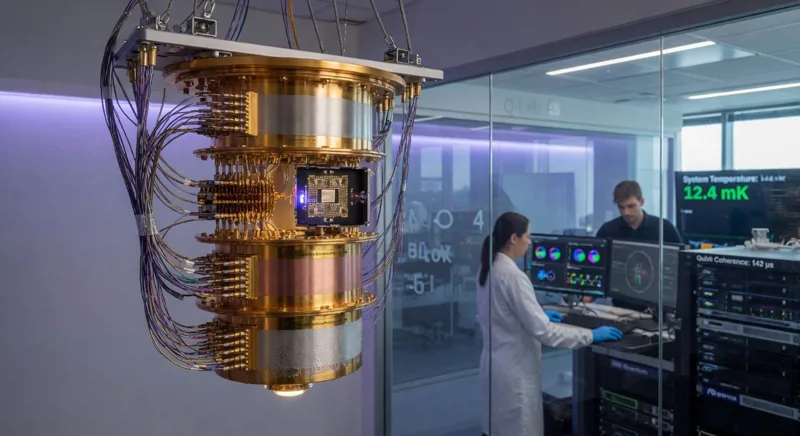
Quantum computing without the sci-fi hype starts with a simple idea: these machines are not magical replacements for laptops or supercomputers. They are specialized systems that may eventually solve certain problems in chemistry, cybersecurity, optimization, and materials science—if engineers can overcome major technical challenges first.
What Is Quantum Computing?
Classical computers process information as bits, represented by zeros and ones. Quantum computers use qubits, which follow the rules of quantum mechanics.
A qubit can exist in a combination of states called superposition. Qubits can also become entangled, meaning their measurement outcomes are correlated in ways that classical systems cannot easily reproduce. Quantum algorithms use these properties to manipulate probability and extract useful answers.
That does not mean a quantum computer tries every possible answer simultaneously and instantly selects the best one. Measurement produces limited information, and algorithms must be carefully designed so that desirable outcomes become more likely.
Quantum Computing Without the Sci-Fi Hype: What It Can and Cannot Do
Quantum computers are not faster at every task. Opening a web browser, editing a document, managing databases, and running most business software will remain better suited to classical computers.
Quantum computing may become valuable for specific mathematical and scientific problems, including:
- Drug discovery and chemistry: Modeling molecular behavior and chemical reactions.
- Materials science: Exploring batteries, catalysts, superconductors, and advanced materials.
- Optimization: Studying complex scheduling, logistics, routing, and portfolio problems.
- Cryptography: Preparing for algorithms that could threaten some current public-key encryption methods.
- Scientific simulation: Representing quantum systems that are difficult to simulate with classical hardware.
Even in these areas, quantum processors will probably work alongside conventional computers rather than operate independently. High-performance computing systems may prepare data, control workflows, and interpret results while the quantum processor handles a specialized calculation.
Why Quantum Computers Are So Difficult to Build
The same properties that make qubits interesting also make them fragile. Heat, vibration, electromagnetic interference, imperfect control signals, and interactions with the surrounding environment can introduce errors.
Many quantum processors therefore operate in highly controlled conditions. Some designs require extremely low temperatures, while others use trapped ions, photons, neutral atoms, or other approaches. Each hardware type has different advantages and engineering obstacles.
Physical Qubits Versus Logical Qubits
A physical qubit is a real hardware element. A logical qubit is an error-protected unit created by combining multiple physical qubits.
This distinction matters because a processor advertised as having hundreds or thousands of physical qubits may still lack the reliable logical qubits needed for long, useful calculations. Quantum error correction requires additional qubits, measurements, decoding systems, and control infrastructure.
Fault-tolerant quantum computing means errors can be detected and corrected during computation without destroying the information being processed. Achieving that capability at scale remains one of the field’s central challenges.
Quantum Advantage Is Not the Same as Quantum Supremacy
Terms such as quantum advantage can sound dramatic, but they need context. Quantum advantage generally means a quantum system performs a particular task better than the best practical classical approach. It does not mean the machine is universally superior.
A convincing advantage must also be useful, repeatable, independently evaluated, and economically meaningful. A demonstration on an artificial benchmark may show technical progress without creating immediate business value.
The important question is not simply, “How many qubits does the computer have?” Better questions include:
- How accurate are the operations?
- How long can the system preserve quantum information?
- How many reliable logical qubits are available?
- Can the algorithm outperform classical methods on a real problem?
- What are the total hardware, cooling, software, and operating costs?
When Will Quantum Computing Become Useful?
There is no single arrival date. Quantum computing is developing through incremental improvements in hardware, error mitigation, software, algorithms, and classical-quantum integration.
Industry roadmaps often describe future fault-tolerant systems capable of running far larger circuits than today’s machines. For example, IBM’s published roadmap targets a large-scale, fault-tolerant system called Starling for 2029, with 200 logical qubits and the ability to execute 100 million quantum gates.[1]
That is a company target, not a guaranteed industry-wide deadline. Timelines can change as researchers discover new engineering constraints. Practical applications may also emerge gradually, beginning with narrow scientific or commercial tasks rather than a sudden technological revolution.
What Quantum Computing Means for Cybersecurity
Quantum computing has an important cybersecurity angle. Large, fault-tolerant quantum computers could eventually threaten widely used public-key cryptographic systems based on mathematical problems such as integer factorization.
That risk is driving interest in post-quantum cryptography, which uses algorithms designed to resist both classical and quantum attacks. Organizations do not need to wait for a powerful quantum computer to begin preparing. Sensitive data can remain valuable for decades, and encrypted information captured today could potentially be targeted later.
Quantum-safe migration involves identifying vulnerable systems, cataloging cryptographic dependencies, testing replacement algorithms, and updating long-lived hardware and software.
How Businesses Should Evaluate Quantum Computing
For most organizations, the sensible approach is education and measured experimentation—not expensive transformation programs based on hype.
- Identify business problems involving complex simulation, optimization, or cryptography.
- Compare quantum approaches with strong classical algorithms and high-performance computing.
- Use cloud-based quantum platforms for learning and prototyping where appropriate.
- Track practical metrics such as error rates, circuit depth, runtime, and total cost.
- Begin post-quantum cybersecurity planning independently of quantum hardware progress.
The Bottom Line
Quantum computing without the sci-fi hype is still a remarkable—and unfinished—engineering story. Qubits do not make every calculation faster, current devices are noisy, and useful fault-tolerant systems require major advances in error correction and scale.
Yet the technology deserves serious attention because it targets problems that classical computers struggle to model efficiently. The realistic future is likely hybrid: classical computers handle most work, while quantum processors tackle carefully selected tasks in chemistry, materials, optimization, and security.
The most accurate view is neither “quantum computers will change everything tomorrow” nor “they are useless.” They are promising specialized tools whose value will be measured by reliable results, practical applications, and economic impact—not by science-fiction headlines.
References
You May Also Like
 Education
The Difference Between Correlation and Causation
 Science
Why Some Studies Cannot Be Replicated
 Science
How to Tell a Breakthrough From a Press Release