Why Physicists Study Neutrinos
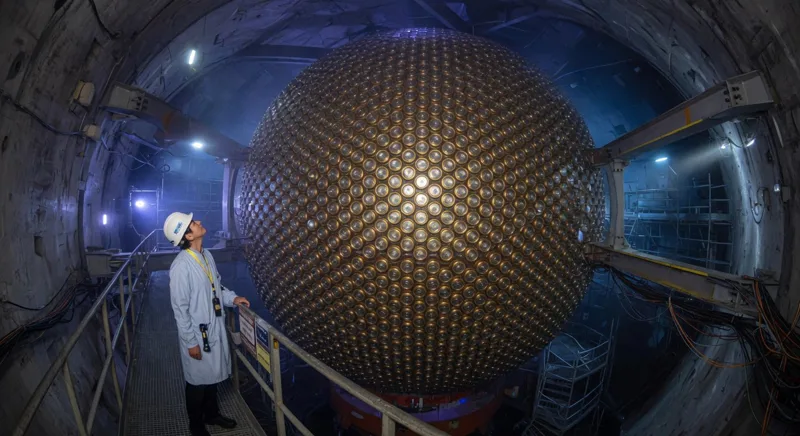
Why do physicists study neutrinos, particles so tiny and elusive that trillions pass through your body every second? Because these nearly invisible messengers can reveal how stars work, why matter exists, and where today’s best theories of physics fall short.
What Are Neutrinos?
Neutrinos are electrically neutral elementary particles produced in nuclear reactions, including those inside the Sun, exploding stars, radioactive decay, and particle accelerators. They have an extremely small mass and interact mainly through the weak nuclear force, allowing them to pass through ordinary matter with remarkable ease.
There are three known neutrino “flavors”:
- Electron neutrinos
- Muon neutrinos
- Tau neutrinos
Because neutrinos rarely collide with atoms, detecting them is difficult. Researchers use enormous underground detectors, carefully controlled neutrino beams, and observatories designed to identify the tiny signals created when a neutrino does interact.
Neutrino Oscillations Revealed New Physics
One of the biggest reasons physicists study neutrinos is a strange behavior called neutrino oscillation. As neutrinos travel, they can change from one flavor into another. An electron neutrino created in the Sun, for example, may later be detected as a muon or tau neutrino.
This discovery solved the long-standing “solar neutrino problem.” For decades, experiments detected fewer electron neutrinos from the Sun than theoretical calculations predicted. The missing particles had not disappeared; many had changed flavor during their journey.
Neutrino oscillations also produced a revolutionary result: neutrinos must have mass. The Standard Model of particle physics originally treated neutrinos as massless, so their oscillations showed that the model is incomplete.[3][4]
Why Neutrino Mass Matters
Scientists know that neutrinos have mass, but the absolute mass of each neutrino remains unknown. Their masses are extremely small, and measuring them directly is one of the major challenges in modern particle physics.
Learning the neutrino mass scale could help researchers answer important questions about:
- How the Standard Model should be expanded
- Whether undiscovered particles exist
- How the universe evolved after the Big Bang
- Why matter is more common than antimatter
- How large-scale cosmic structures formed
Even a tiny neutrino mass affects the movement of galaxies and the growth of cosmic structure. In this way, neutrino physics connects the smallest known particles with the largest features of the universe.
Neutrinos May Explain the Matter–Antimatter Mystery
The universe contains vastly more matter than antimatter, yet many fundamental equations suggest that the early universe should have produced both in nearly equal quantities. This imbalance is one of physics’ biggest unanswered questions.
Physicists compare neutrinos and antineutrinos to search for differences in how they oscillate. A difference known as CP violation could provide clues about why matter survived while antimatter largely disappeared.
Long-baseline neutrino experiments produce beams at particle accelerators and send them over hundreds of kilometers to distant detectors. By comparing the behavior of neutrinos and antineutrinos, researchers can investigate whether their oscillations differ and determine key properties such as the neutrino mass ordering and the CP-violating phase.[1][2]
Neutrinos Let Scientists See Inside the Sun
Light from the Sun takes time to escape from the solar interior, but solar neutrinos travel almost directly from the nuclear reactions where they are created. That makes them valuable probes of the Sun’s core.
Studying solar neutrinos helps physicists test models of:
- Nuclear fusion inside stars
- The Sun’s temperature and chemical composition
- Energy production in stellar cores
- Neutrino interactions with matter
Unlike ordinary telescopes, neutrino observatories can provide information about regions hidden beneath a star’s surface.
Supernova Neutrinos Carry a Cosmic Warning
When a massive star collapses, most of its energy is released as neutrinos. These particles escape from the dense stellar core before the explosion becomes visible in light.
Detecting neutrinos from a nearby supernova could reveal how the core collapses, how heavy elements form, and whether a neutron star or black hole is created. Supernova neutrinos may also help scientists understand the history of stellar explosions throughout the universe.
What Can Neutrino Experiments Reveal?
| Research area | Why it matters |
|---|---|
| Neutrino oscillation | Shows how neutrino flavors change and helps measure mixing properties. |
| Neutrino mass | Tests the limits of the Standard Model and clarifies cosmic structure. |
| Neutrino versus antineutrino behavior | May help explain the universe’s matter–antimatter imbalance. |
| Solar neutrinos | Reveal the nuclear processes powering the Sun. |
| Supernova neutrinos | Provide early information about stellar explosions and compact objects. |
Why Are Neutrinos So Difficult to Detect?
Neutrinos have no electric charge and interact very weakly with matter. A detector must therefore be large enough to contain vast numbers of atoms, while sensitive enough to recognize rare collisions.
Many neutrino observatories operate deep underground. The surrounding rock shields them from cosmic rays and other background signals. Experiments may also use water, liquid scintillator, or specialized materials to record the flashes and particles produced by neutrino interactions.
The Future of Neutrino Physics
Current and planned experiments aim to determine the neutrino mass hierarchy, measure possible CP violation, improve direct mass measurements, and search for hypothetical particles such as sterile neutrinos. Researchers also continue to investigate whether neutrinos are their own antiparticles, a possibility that could illuminate the origin of matter.
These questions explain why physicists study neutrinos despite their stubbornly faint signals. Neutrinos are difficult to observe, but that weakness is also their strength: they travel through stars, planets, and cosmic distances carrying information that other particles cannot easily deliver.
In short, neutrino research is a search for hidden connections. It links quantum mechanics to cosmology, nuclear physics to astronomy, and the behavior of microscopic particles to the history of the entire universe. Every neutrino detected may bring science closer to understanding what the universe is made of—and why it exists in its present form.
You May Also Like
 Education
The Difference Between Correlation and Causation
 Science
Why Some Studies Cannot Be Replicated
 Science
How to Tell a Breakthrough From a Press Release