The Life Scientists Find in Deep-Sea Darkness
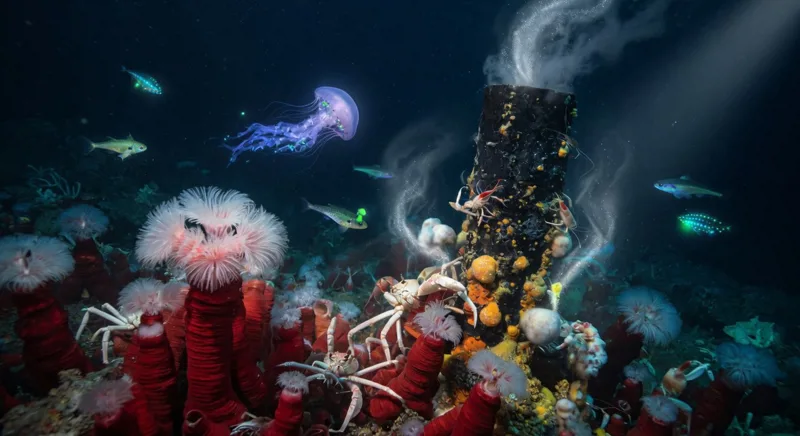
Far below the sunlit surface, where pressure is immense and food is scarce, life has evolved in astonishing ways. The life scientists find in deep-sea darkness survives without sunlight, builds food webs from chemicals, and may reveal clues about Earth’s earliest ecosystems—and life beyond our planet.
Where Does the Deep Ocean Begin?
The deep ocean is commonly described as water below about 200 meters, where sunlight quickly fades. At greater depths, darkness becomes permanent. Temperatures can approach freezing, pressure rises dramatically, and the seafloor may be covered by sediment, rock, or rugged volcanic terrain.
These conditions might seem hostile, yet the deep sea is not lifeless. It contains microscopic organisms, jellyfish, crustaceans, worms, mollusks, fish, corals, and other animals adapted to extreme environments. Scientists continue to discover new species because much of the deep ocean remains difficult to reach and study.
How Can Life Survive Without Sunlight?
In most familiar ecosystems, plants and algae use sunlight to create food through photosynthesis. Deep-sea communities often follow a different energy pathway: chemosynthesis.
Chemosynthetic bacteria and archaea use energy released by chemical reactions. Depending on the habitat, they may process hydrogen sulfide, methane, hydrogen, iron, or other compounds. These microorganisms convert chemical energy into organic matter, creating the foundation of a food web without sunlight. [1][4]
This discovery changed how scientists think about the requirements for life. Sunlight is essential for many ecosystems, but it is not the only possible energy source. In the deep ocean, chemistry can take the place of light.
Hydrothermal Vents: Natural Laboratories Beneath the Waves
Hydrothermal vents form when seawater moves through cracks in Earth’s crust, becomes heated by volcanic activity, and rises back through the seafloor. The resulting fluid carries dissolved minerals and chemicals into the cold surrounding ocean. These vents are frequently found near tectonically active regions. [4]
Some vent fluids are extremely hot, but nearby water is much colder. This creates sharp chemical and temperature gradients. Microbes thrive where the fluids mix with oxygenated seawater, and larger animals gather around these productive zones.
A hydrothermal vent ecosystem may include:
- Microbes that perform chemosynthesis
- Giant tube worms supported by bacterial symbionts
- Clams and mussels that house chemosynthetic bacteria
- Shrimp, crabs, snails, and specialized deep-sea fish
- Predators that feed on animals living near the vent
Rather than relying on plants, this entire community is powered by microorganisms using chemical energy. In some cases, a single microbial partnership allows an animal to obtain nourishment in an otherwise food-poor environment. [2]
Cold Seeps and Methane-Based Ecosystems
Hydrothermal vents are not the only chemical oases in the deep ocean. Cold seeps occur where methane, hydrogen sulfide, and other fluids slowly escape from seafloor sediments.
Although seep fluids are not necessarily hot, they can support dense biological communities. Methane-oxidizing microorganisms consume methane and help transfer chemical energy into the food web. These microbes also influence carbon cycling and support symbiotic relationships with clams, mussels, and tube worms. [3]
Cold seep ecosystems can remain active for much longer than individual hydrothermal vents. Their communities may include unusual animals found nowhere else, making them important sites for research into deep-sea biodiversity and evolution.
Remarkable Adaptations to Deep-Sea Darkness
The animals scientists find in deep-sea darkness have evolved specialized solutions to extreme conditions. Many species are bioluminescent, producing light through chemical reactions. This glow can help them attract prey, communicate, find mates, or confuse predators.
Other adaptations include:
- Large eyes or highly sensitive light-detecting organs
- Expandable mouths and stomachs for capturing scarce meals
- Slow growth and long lifespans that conserve energy
- Flexible bodies suited to intense water pressure
- Dark, red, or transparent coloring that reduces visibility
- Specialized bacteria living inside animal tissues
Not every deep-sea organism depends on chemosynthesis. Much of the open deep ocean receives falling organic material from above, sometimes called marine snow. Dead plankton, waste, and fragments of marine life drift downward, feeding animals and microbes along the way.
How Scientists Explore the Deep Sea
Studying deep-sea life requires sophisticated technology. Research vessels use sonar to map the seafloor, while remotely operated vehicles transmit video and collect samples. Autonomous underwater vehicles can survey large areas without a continuous cable connection.
Scientists also use:
- Submersibles: Crewed vehicles allow researchers to observe habitats directly.
- Environmental DNA: Water and sediment samples can reveal organisms from genetic traces.
- Seafloor observatories: Sensors monitor temperature, chemistry, pressure, and biological activity.
- Microbial genomics: DNA analysis identifies how microbes obtain energy and interact with hosts.
- Specimen imaging: High-resolution cameras document fragile animals before collection.
These methods are especially valuable because deep-sea ecosystems can be delicate, isolated, and difficult to revisit. A single expedition may reveal new species, new chemical processes, or unexpected connections between distant habitats.
Why Deep-Sea Life Matters
Hydrothermal vents and cold seeps are more than biological curiosities. Their organisms participate in the cycling of carbon, sulfur, nitrogen, and other elements. Deep-sea microbes may also contain enzymes with potential value for biotechnology, medicine, and industrial research.
These ecosystems offer clues about the origin of life because they combine water, minerals, chemical energy, and strong environmental gradients. Similar conditions may exist beneath the icy surfaces of moons such as Europa and Enceladus, which is why deep-sea research is relevant to astrobiology.
At the same time, deep-sea habitats can be vulnerable to disturbance from climate change, seabed mining, pollution, fishing, and industrial activity. Their slow growth and specialized communities may make recovery difficult after damage.
The Deep Ocean Still Holds Major Mysteries
The life scientists find in deep-sea darkness challenges the idea that darkness means emptiness. From microbial communities powered by sulfur to animals sustained by methane-consuming bacteria, the deep ocean demonstrates how inventive evolution can be.
As exploration technology improves, researchers will likely uncover more species and more ways life survives without sunlight. The deepest parts of the planet are not merely remote places—they are living laboratories that broaden our understanding of biology, Earth’s chemistry, and the possibility of life elsewhere.
You May Also Like
 Education
The Difference Between Correlation and Causation
 Science
Why Some Studies Cannot Be Replicated
 Science
How to Tell a Breakthrough From a Press Release